A signature is evidence, not decoration.
Brand Guide §08 already settled this: real ink, never a script font. These files are what that rule points at.
- Place the master. Never set a name in an italic face and call it a signature. An italic name is a stand-in for a signature that has not been applied yet.
- A signature is not a logo. It never replaces the wordmark, never appears in navigation, on merchandise, or in a lockup, and never marks a page the way a mark does.
- Never redraw, retrace, or generate one. Scale the vector. If the size or color you need does not exist, request it.
- Only on Parchment or white. The ink is Midnight, so a dark ground erases it. Nothing signed goes on Midnight, on Word Blue, or over footage until a reversed master is published.
- Only on a document the signer has approved. Placing a signature is an act of the record. It is not a design decision.
Four masters.
Three forms of the full name and one short form. Each one is a single closed path with proper interior counters, so it stays crisp at any size. Ink is Midnight #0B1A2D.
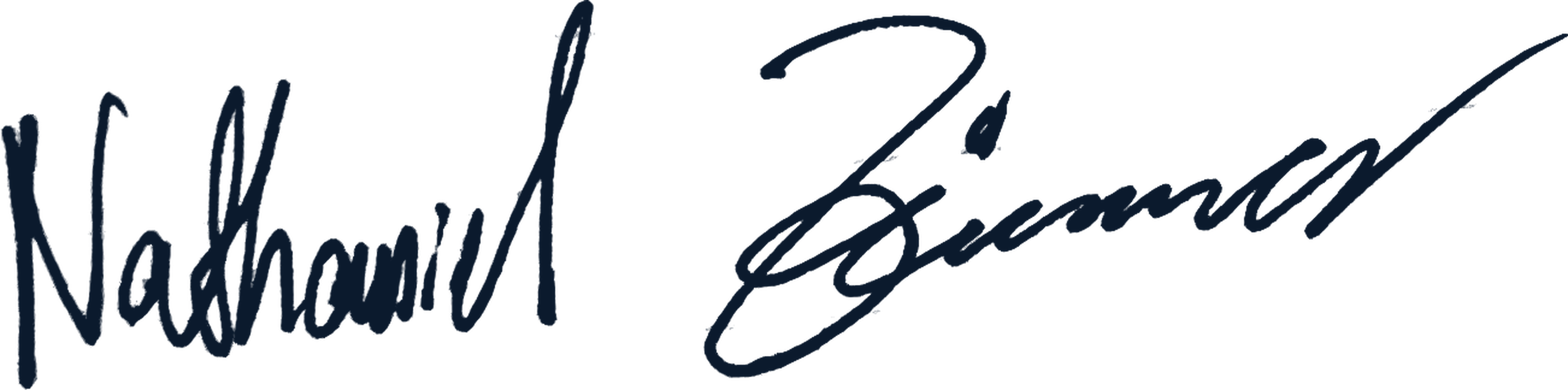
Nathaniel Zimmer
nathaniel-zimmer.svg
The default. Cleanest of the three full forms and the most legible, so it is the one to use on documents and letterhead unless there is a reason to reach for another. This is the signature placed on the initiative documents.
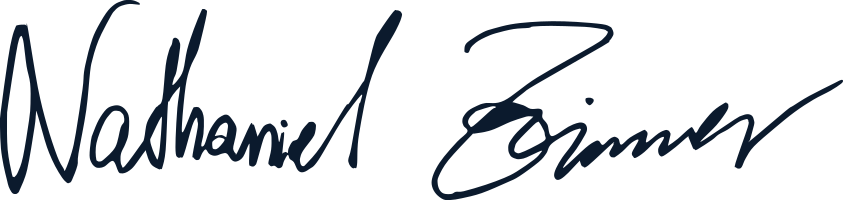

Nathaniel Zimmer, display
nathaniel-zimmer-display.svg
Faster and more slanted, with a long lead-in on the N and a trailing flick. It holds its energy at large sizes. Not for small settings, where the flick reads as noise.
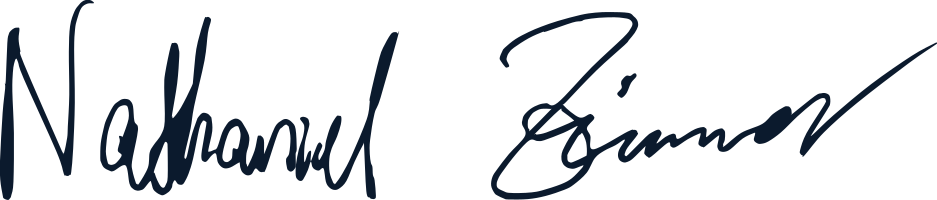
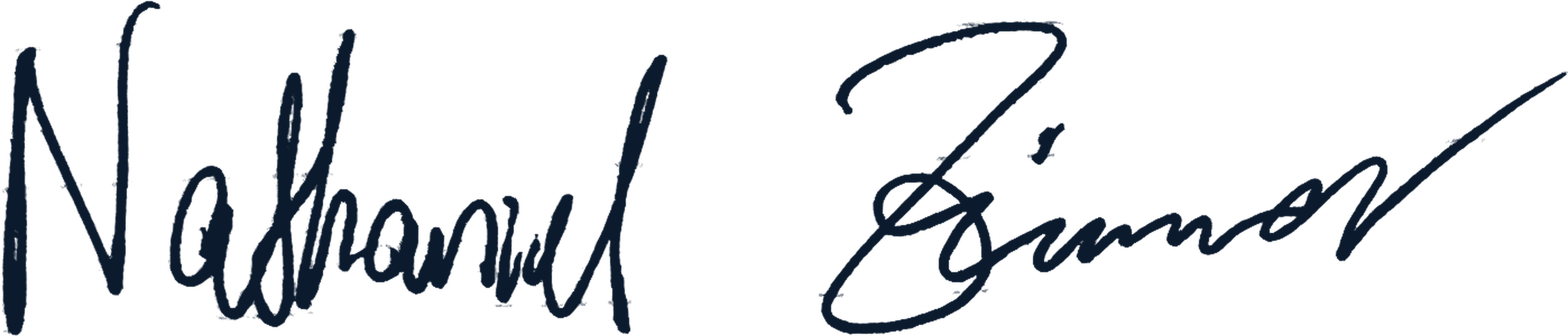
Nathaniel Zimmer, compact
nathaniel-zimmer-compact.svg
Tightest of the three, with heavier looping on the Z. The one that survives being scaled down.
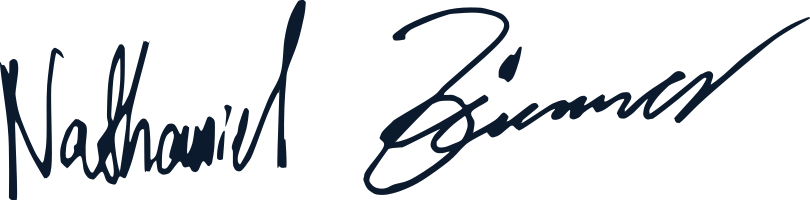
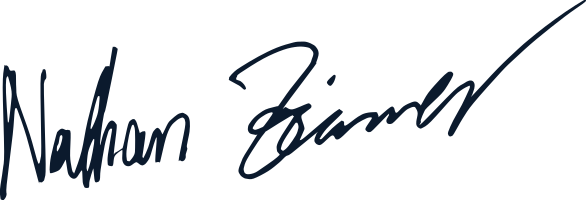
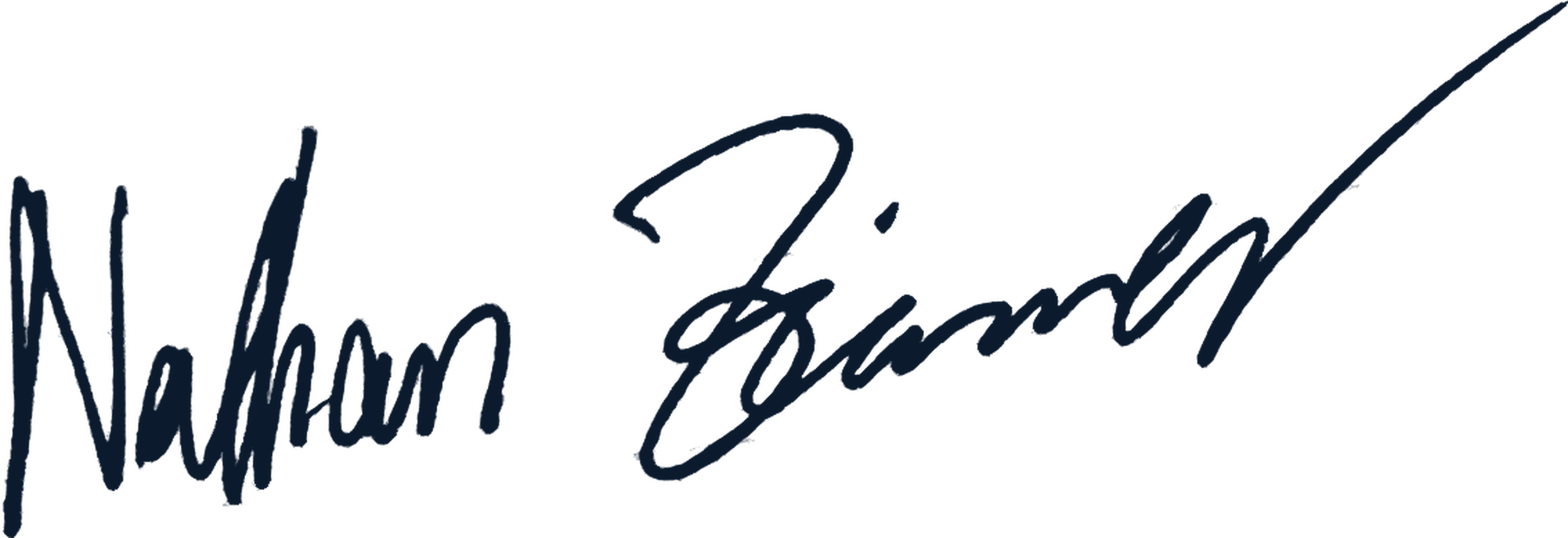
Nathan Zimmer, short form
nathan-zimmer.svg
The short form. Widest stroke relative to its width, so it stays readable in tight spaces like an email footer. Use a full-name form on anything entered into the record.
SVG everywhere it is accepted.
The vector is the master. Reach for the PNG only where the destination refuses SVG. Every PNG is transparent and 1200px tall, so it stays sharp in print.
| Where | Use | Why |
|---|---|---|
| A page in this portal | .svg | Scales with the layout, adds no network weight worth counting. |
| Microsoft Word | .svg | Insert, then Pictures. Stays sharp when printed or exported to PDF. |
| Google Docs | .png | Docs will not import SVG. |
| PDF forms and e-sign | .png | Transparent, so it sits over a ruled signature line cleanly. |
| Email signature | .png | Most email clients block SVG. Scale to roughly 180 to 220px wide. |
| Figma or Illustrator | .svg | Imports as an editable path, so it can join a shared library. |
Reversing it: change the fill value in the SVG to #FFFFFF. Never invert the PNG, which produces a grey halo where the strokes were anti-aliased. A reversed master is not published yet, so a reversed signature is not approved for release until one is.
Everything here is machine-readable.
Every file on this page is listed in /ai/assets.json with its status, its approved grounds, and its usage note, and the gap for the reversed master is recorded there too. An agent working on a signed document reads that file rather than this one.